Some experts asked why it is pig in the character not other animals, like Cow or Goat? Simple, it is easy to raise pigs than cows and goats because pig is docile, omnivorous, growing fast.家 (jiā, "home/family") = Roof + Pig
The component 宝盖 (the "roof" radical) represents a pigsty or shelter, while 豕 means "pig." Together, the character depicts a pig being kept under a roof—that is, a domesticated pig raised by humans.
Why does raising pigs represent a home?
In the earliest times, people survived through hunting and gathering. They could not remain in one place permanently; they had to follow wild animals wherever they could find them. Once people learned how to raise pigs, however, they were no longer completely dependent on hunting for meat. This made it possible to settle down and establish permanent homes. Therefore, our ancestors used the image of a domesticated pig under a roof to express the idea of a home or household.
In this artwork, there are five forms of the character 家, and every one of them consists of a roof above the character 豕, meaning "pig." See if you can identify them all.
Shell Bone Script (甲骨文) — top
Bronze Script (金文) — middle left. The pig is the easiest to recognize in this form.
Big Seal Script (大篆) — middle right
Small Seal Script (小篆) — bottom left
Clerical Script (隶书) — bottom right
Thursday, June 11, 2026
Home - 家
Sunday, April 5, 2026
奋(奮)- I am just a little bird, wanting to fly, yet unable to fly high.
The above is the bronze script form of the character “奋” (fèn).
Strictly speaking, I’m not creating something new—I’m simply writing it with a brush. This can be called Chinese calligraphy. Of course, since it is highly pictographic, calling it pictographic calligraphy is also perfectly appropriate.
This is a character well worth introducing to everyone.
It is composed of three parts: 衣 (clothing), 隹 (a small bird), and 田 (field).
衣: the top and the sides
隹: inside the “衣” — it represents a small bird
田: at the bottom
In ancient times, people used clothing to catch small birds in the fields. Once caught, they would cover the bird with the garment. The bird would struggle desperately, trying to fly away, but wrapped in the cloth, it could not take flight.
The ancients used the bird’s behavior in this situation to express the meaning of “奋”: desperation, helplessness, yet exerting all one’s strength and never giving up.
To keep striving in a desperate situation—that is “奋” (奮).
This character perfectly illustrates the lyrics of “I Am a Little Bird” by Jonathan Lee(李宗盛):
“I am just a little bird,
wanting to fly, yet unable to fly high.”
One could also say that Jonathan Lee’s lyrics perfectly capture the original meaning of the character “奋”(奮).
The character “奋” (奮) moved me, and so did Jonathan Lee’s song. Bringing the two together felt completely natural.
Monday, March 2, 2026
Tuesday, November 18, 2025
Blessing - 福, one of the most popular characters in Chinese daily life
Character Blessing - 福 is one of the most popular characters in Chinese daily life, even people who didn't have any education know the character.
You can find the character on red paper on doors, windows, inside of the room, and more. It is people's wish, hope, and prespective.
The following are character 福 in different script.
1, shell bone script
2, bronze script
The left is a table, the right is a liquor jar, not like the real objects any more because the lines changed from curve to straight.
Saturday, November 25, 2023
Pictographic Chinese Calligraphy (80) Thinking Elephant - 想象
Tuesday, July 4, 2023
Thursday, April 27, 2023
Pictographic Chinese Calligraphy Announcement: the URLs will change
In Jan 10, 2024, the URLs for Amazing Chinese Characters and Pictographic Chinese Calligraphy will not work any more.
The URL for Amazing Chinese Characters will become
https://learnchinesewithfun.blogspot.com
The URL for Pictographic Chinese Calligraphy will become
https://creativechinesecalligraphy.blogspot.com
Please bookmark the above two URLs.
The two URLs are working right now, they are permanent URLs. You may change the bookmarks right now.
You can contact me on Facebook at:
https://www.facebook.com/lewei.shang
if you have any problem.
Tuesday, January 17, 2023
Preface
The Pictographic Chinese Calligraphy is an art of pictography of Chinese characters by emphasizing the pictography of characters to form a drawing alike calligraphy. Chinese always say that Chinese is half drawing and half language, which means that the characters are drawings and also language units, a unique art or language in the world. However, no one has ever tried to show this characteristics in the real artworks.
Let me give a few examples.
The shell bone script of character Water is
The middle is river, the four dots are water drops. Ancient Chinese got. water from river, they drew a river with water drops to present Water. The character is very pictographic, the simplest drawing in the world. Chinese describes the unique characteristics of Chinese characters as "Half language and half art" (亦字亦画).
Because the evolution of Chinese characters caused the loss of the pictography of the old characters, for example, the character Water becomes
Almost no one couldn't tell which stroke represents which if he/she doesn't know the old scripts. Unfortunately, no text book, no teacher, no school are teaching students the old scripts in China, and overseas. People have no idea what the pictography of Chinese characters, even never heard of, the great characteristics has been ignored for at least two thousand of years.
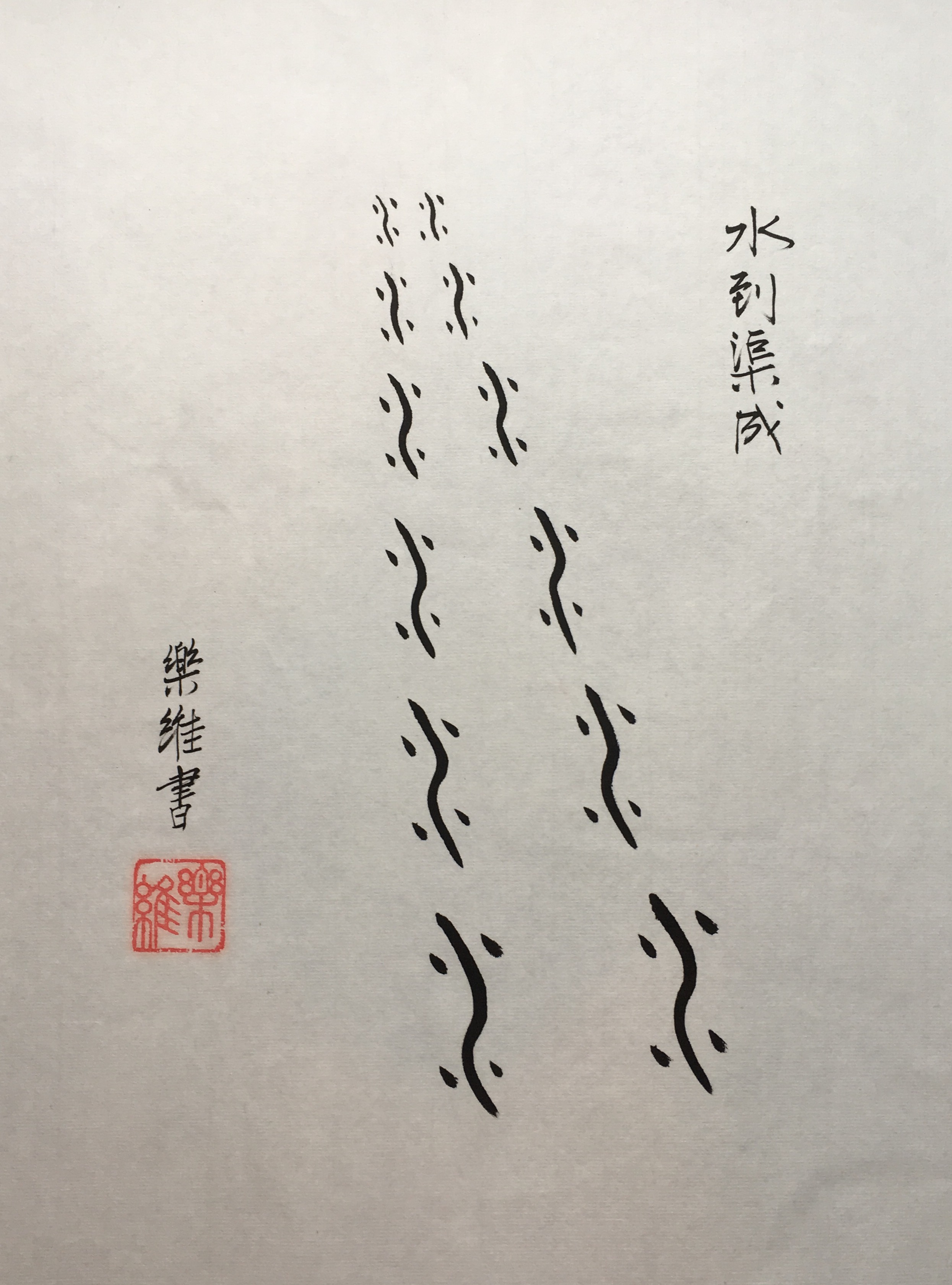
Let me show you how easy we can make a unique "half language and half art" Chinese pictographic calligraphy. I used the shell bone script of character Water as the only unit, created the following artwork:
Does it look like a river flowing from far?
Have you ever seen any drawing like this? No, you haven't.
I have tried to create drawing alike Chinese calligraphy since 2013, this blog is showing part of the artworks I have created in the last almost 10 years.
Because they are drawings, everyone can appreciate the artworks even not knowing any Chinese.
The first 43 artworks have been published in the book "Pictographic Chinese Calligraphy" on Amazon. If you are interested in those artworks, you can read them for free if you are kindle unlimited member, or you can buy the book, there are eBook, paperback, or hardcover.
Pictographic Chinese Calligraphy (78) You Rabbit, Me Rabbit - You 兔,Me 兔
Saturday, December 31, 2022
Pictographic Chinese Calligraphy (77) Ring out 2022, Ring in 2023
Saturday, September 17, 2022
Pictographic Chinese Calligraphy (76) American Dream - American 梦
The Chinese character in the artwork
is character Dream of shell bone script.Wednesday, June 22, 2022
Pictographic Chinese Calligraphy (75) Terracotta Warriors - 兵马俑
Chinese call "Terracotta Warriors" as 兵马俑. 兵-Soldier, 马-Horse, 俑 - Figurine.
The characters in the artwork
1, Soldier - big seal script
The top is Axe, a weapon in ancient time. The bottom two fork alike are two hands holding the Axe.2, Vehicle - shell bone script
3, Horse - small seal script
Thursday, April 7, 2022
Pictographic Chinese Calligraphy (74)Cao Chong Weighs the Elephant - 曹冲称象
During 220-280, it is called Three Kingdoms Era in China. One was Wei, its King was Cao Cao. He had many sons, one was Cao Chong, who was very smart.
When he was six years old, Sun Quan, the King of Wu, gave an elephant to Cao Cao as a gift. Cao Cao wanted to know the weight of the elephant, he asked his ministers how to get the weight of then elephant. No on had the answer. Cao Chong, who told his father :"I know how to do it". His father let Chong say it.
Chong said:"We can lead the elephant to the board of a boat in river, and mark the watermark. We replace the elephant with stones until reaching the watermark, and we weigh the stones in batches, and add them up to get the weight of the elephant".
Chong's amazing idea solved the problem all adults couldn't. The story became one of the most famous stories in Chinese history, now it is in school text book for all primary school students.
Here is my artwork "Cao Chong Weighs the Elephant".
The characters in the artwork:
1, Elephant
2, BoatThursday, March 31, 2022
Pictographic Chinese Calligraphy (73) Black fungus - 黑木耳
Black fungus (Auricularia polytricha) is a popular food in China. Chinese call it as Black Wood Ear, because it looks like ear and growth on wood.
Let's see the three Chinese characters.
The big seal script of character Black is
The clerical script of Black
The shell bone script of character Black isTuesday, March 22, 2022
Pictographic Chinese Calligraphy (72) Imagine - 想象
Characters in the artwork
Think - big seal script.
The top is Wood (left) + Eye (right), means "Observe trees", the bottom is Heart. Ancient Chinese believed that people think from heart, at least heart is important same as the brain in thinking.
The character means "Think or Thinking".
Elephant - shell bone script.
Think Elephant = Imagine. Why is not "Think Pig", "Think Dog", "Think Horse", "Think Tiger" ?
There were elephants living in Yellow river area long long time ago. Ancient Chinese saw elephants, so they could draw elephant in shell bone script. However, as the weather changed, the forest in Yellow river area disappeared, many elephants died due to lack of food, some might have moved to south. The elephants gradually disappeared in Yellow river even most of China. Gradually, the younger generation had ever seen elephants, they only heard the older generatuon told them what elephant looks like, they had to imagine the animal in their brain. Therefore, thinking elephant is a process of imagination.
Because people could easily see all other animals, didn't need imagination, elephant is the only animal in ancient China people needed imagination to get its image.
Wednesday, February 9, 2022
Pictographic Chinese Calligraphy (71) Long Time No See - 好久不见
Home - 家
家 (jiā, "home/family") = Roof + Pig The component 宝盖 (the "roof" radical) represents a pigsty or shelter, while 豕 ...
-
The above is the bronze script form of the character “奋” (fèn). Strictly speaking, I’m not creating something new—I’m simply writing i...
-
Character Blessing - 福 is one of the most popular characters in Chinese daily life, even people who didn't have any education know the ...
-
2023 is Year of Rabbit. The Chinese characters in the artwork above: 1, Shell bone script of Rabbit 2, Big seal script of Rabbit Changed a l...


.gif)


门:甲骨文
福:五个不同字体的福:甲骨文,金文,大篆,小篆,隶书。
甲骨文的福(最上面的),大家没有见过,需要解释一下:左边是一个桌子,祭祀用的。右边是一个架子上的酒坛,从酒坛撒酒到祭祀的桌子上(可以看见三滴酒在空中),用来祭祖,祭神,祭天。为什么用酒?因为古代的人吃不饱,所以用粮食酿的酒是非常珍贵的,是人们最好的东西。另外,酒有挥发性,可以通达上天,可以与神,天,祖先沟通,传达人们的愿望。
金文,大篆福字都是左边是“示”(一个桌子上放东西),一个酒坛。
小篆,隶书把右边的酒坛分开了,失去了象形。但仍然表示的是酒坛。
Work Explanation
Men (门 - Door): Rendered in Shell Bone Script.
Fu (福 - Blessing/Good Fortune): Five versions in different calligraphic styles: Shell Bone Script, Bronze Inscriptions, Big Seal Script, Small Seal Script, and Clerical Script.
The Shell Bone version of "Fu" (at the very top) is likely unfamiliar to most, so it requires some explanation:
The Left Side: Represents a table or altar used for sacrificial rituals.
The Right Side: Depicts a wine jar on a rack. You can see wine being poured from the jar onto the ritual table (three drops of wine are visible in the air).
This imagery represents a ritual to worship ancestors, gods, and the Heavens.
Why was wine used? In ancient times, food was scarce. Therefore, wine brewed from precious grain was considered an extremely valuable possession—the very best thing people had to offer. Furthermore, because alcohol is volatile, its vapor was believed to rise and reach the Heavens, serving as a medium to communicate with gods and ancestors to convey the people's wishes.
Evolution of the Character:
Bronze Inscriptions & Big Seal Script: The left side evolved into the radical “示” (shì), which depicts an altar table with offerings, while the right side remained a wine jar.
Small Seal & Clerical Script: The right side (the wine jar) became fragmented in form, losing its original pictograph appearance. However, it still symbolically represents the wine jar.